

Monday 9th to Sunday 15th March 2026
It's fairly quiet on the astronomy front next week, so I'm going to suggest trying a little visual experiment on the morning of Tuesday 10th. If you look towards the south at
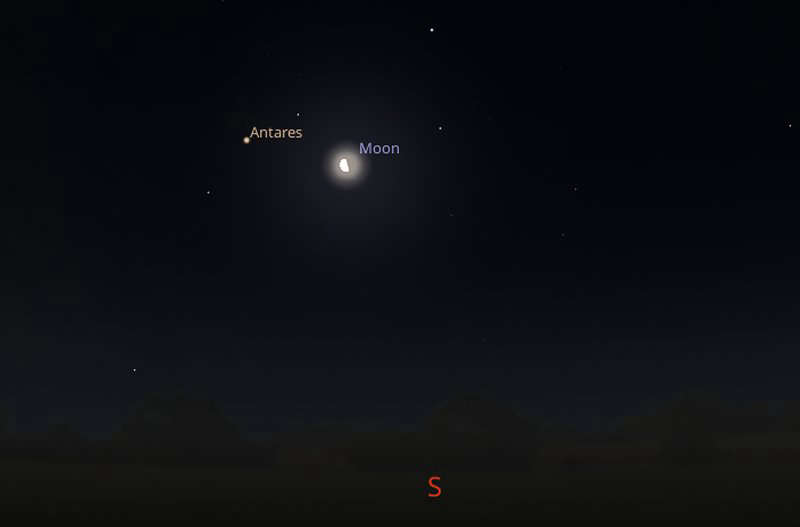
The Moon will have a magnitude of around -10.0 and Antares, being one of the brightest stars in the night sky, will be twinkling around -1.65
By
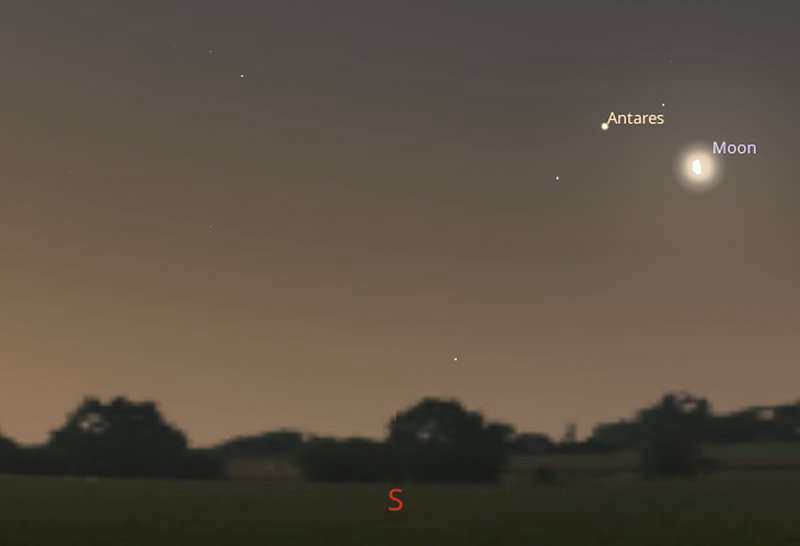
By
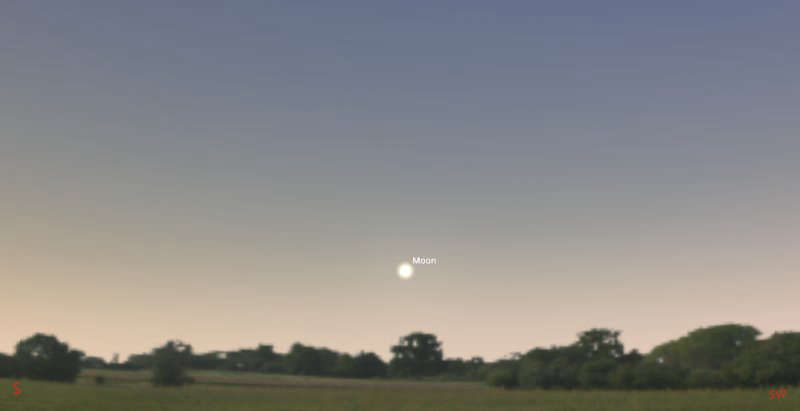
Now why is this? Sunlight is very bright and it is described as "white light" which is a combination of all the primary colours. Because it is so bright, it completely "washes out" the contrast of fainter things like stars. The sky appears blue because the air molecules in our atmosphere scatter the blue component of the white light which has a shorter wavelength than the colours towards the lower "red" end of the visual light spectrum.
Stars twinkle, but the Moon and other planets in the Solar System don't. The light from a star is generated by the star itself and it then has to travel many light years to reach us, by which time it is relatively weak and it then has to pass through our atmosphere, which distorts the light and creates the twinkle. You only see the Moon and planets because sunlight reflects off their surface, plus they are much closer to us, so the twinkling effect is not noticeable due to the much higher brightness.
www.starsoversomerset.com
Screenshots courtesy of Stellarium
Copyright Adrian Dening and Radio Ninesprings 2026
 False Fire Alarms
 Dog DNA
 Mobile Phones in Vehicles
 Car Free Route
 Clean up our Countryside
 Church Bats