
Monday 6th to Sunday 12th April 2026
Venture outside any evening next week after, say
If you look towards the south west around that time, there will be plenty to see. Jupiter will be obvious, shining at a magnitude of about -2.0 and below Jupiter you will see the constellation of Orion, with its bright stars Betelgeuse and Rigel that have magnitudes of +0.45 and +0.15 respectively. Remember that the magnitude scale works backwards, so the more positive the number, the fainter an object is. If something has a negative number, it is very bright, like Jupiter. With the naked eye from a dark location, you can resolve objects down to about +6.0 on the magnitude scale.
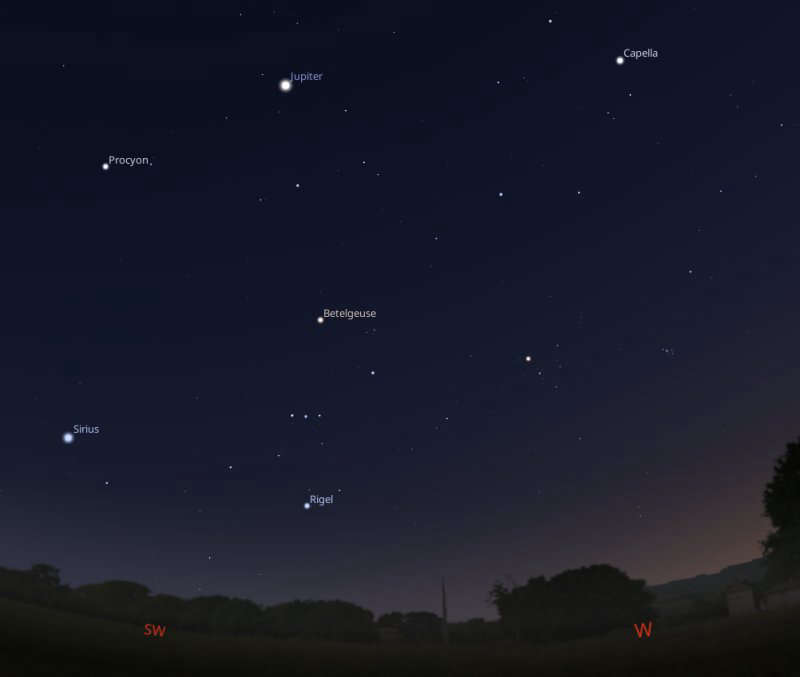
To the left of Orion, you will find the brightest star in the night sky, Sirius, that has a magnitude of -1.45 which is almost as bright as Jupiter. Two more of the brightest stars will be located either side of Jupiter - to the left will be Procyon with a magnitude of +0.4 and Capella, magnitude +0.05 to the right.
To the right of Orion, more to the west, will be a further bright star, Aldebaran and to the right of that, the Pleiades open cluster of stars. Aldebaran has a magnitude of +0.85, while the Pleiades overall is around +1.2
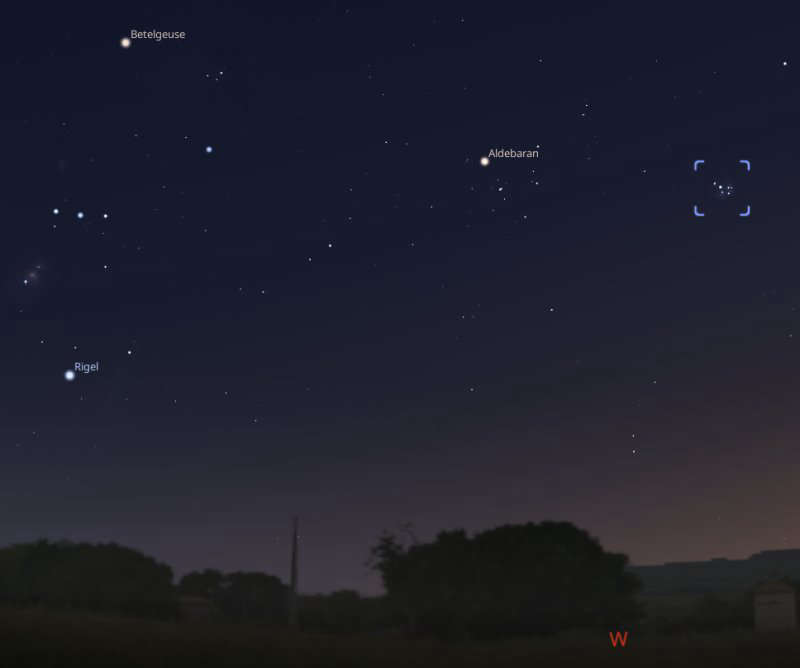
Now it's all well and good constantly quoting these figures, but does it really matter? Why not spend a few minutes observing to see whether you can spot a noticeable difference between everything using your naked eye. Some of the stars I have mentioned are red giants - can you identify them compared to the younger stars that have a more blueish colour?
www.starsoversomerset.com
Screenshots courtesy of Stellarium
Copyright Adrian Dening and Radio Ninesprings 2026
 Clean up our Countryside
 Church Bats
 Dog DNA
 Car Free Route
 False Fire Alarms
 Mobile Phones in Vehicles